Welcome, please be advised that this is a work in progress and the lexicon will be updated and added to over a long period of time. The purpose is mainly to give students and people new to Marx a very basic understanding of terms. I have tried where possible to walk the almost impossible path of explaining Marx using his own terms, so where I have explained surplus value it will be in reference to value rather than profit, however for people new to Marx I have also tried to use familiar terms. Where I have used a familiar mainstream term such as profit…..please note this is in a different FONT to denote the fact that I won’t use this term again.
Abstract Labour
“On the one hand, all labour is an expenditure of human labour-power, in the physiological sense, and it is in this quality of being equal, or abstract, that it forms the value of commodities. On the other hand, all labour in an expenditure of human labour-power in a particular form and with a definite aim, and it is in this quality of being concrete useful labour that it produces use values.” Karl Marx. Capital Volume One Part 1
What is common to all commodities is labour, when we look at various commodities we no longer see which specific and particular type of labour has been used in their making.
“If we make abstraction from its use value, we make abstraction at the same time from the material elements and shapes that make the product a use value; we see in it no longer a table, a house, yarn, or any other useful thing. Its existence as a material thing is put out of sight. Neither can it any longer be regarded as the product of the labour of the joiner, the mason, the spinner, or of any other definite kind of productive labour. Along with the useful qualities of the products themselves, we put out of sight both the useful character of the various kinds of labour embodied in them, and the concrete forms of that labour; there is nothing left but what is common to them all; all are reduced to one and the same sort of labour, human labour in the abstract” Capital Vol One Part 1
When we come to exchange, we are no longer looking at use value or concrete labour. In exchange the commodity has an exchange value based upon the labour-power used, at the point of exchange there is an abstraction from concrete and particular labour/concrete labour and use value to abstract labour in general, because all commodities are made with one thing in common- labour-power.
Accumulation
Accumulation operates through the coercion of capitalists to compete. Capital is self-expanding value. Accumulation is where surplus value is reinvested in order to increase in-puts of resource and labour-power to again increase surplus value. In very simple terms, think about starting your own small business with a small investment. You put the money to work by buying resources and labour-power. You exchange your products for money. At the end of the first month you have wages to pay, and to pay for the other inputs. You have x sum left over. You need to pay for your Tesco delivery so you don’t starve so you take a wage. What is left over to reinvest in your small business? is it equal to, or greater than your initial investment? If it is less than you initial investment your business is going to fail! if its equal to, your business will be able to buy an equal amount of resource and labour-power in order to create the same amount of products again. However, you will not be able to compete against your rival who is able to expand his business. It is argued that Marx talks of “Capital” in Vol one and Vol two, only looking at competition in Vol three, I would argue that Marx already has in mind that competition when he starts to write about accumulation. (please refer to reading the Grundrisse for further explanation).
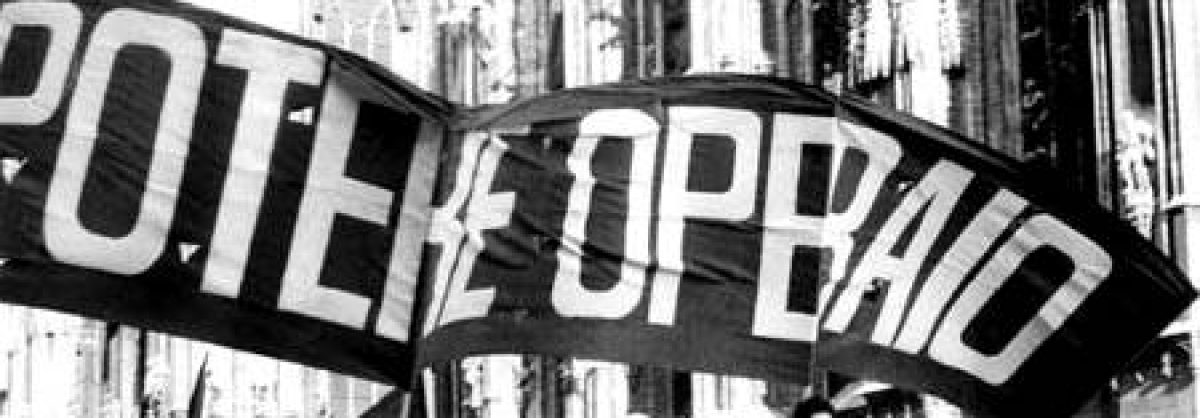
Autonomia Operaia Italian Marxists, Worker’s Autonomy. Decentralised group in Italy around the 1970’s.
Autonomist Marxism Autonomism finds its roots in the works of Mario Tronti who wrote Lenin in England in 1966. Tronti argued that the antagonism between labour and capital is what drives capitalism to revolutionise the means of production and what pushes capitalism to crisis. Autonomist theory posits that capitalism is in the weaker position having to react to the imposition of labour.
Autonomist Theorists Mario Tronti, Antonio Negri, Franco (Bifo)Berardi, Paulo Virno, Silvia Federichi, Harry Cleaver, John Holloway.
Alienation
Marx said that when men looked upon the huge mass of commodities in the market, man didn’t see the embodied labour in these commodities. We don’t see the particular and specific labour-power that produces them. We don’t see the people that produce these commodities. We create a powerful world of objects, of laws and social norms to which we then enslave ourselves. We are dependant upon other people, even more so under capitalism and yet we don’t see the expended life work and labour of other men when we look upon all the vast products of that labour. So it can be said we are alienated from others. In alienating them from their labour, we do likewise with our own. If we fail to see our dependence on others we are alienated from them, them from us, and all of us self-alienated in relation to our understanding of how our social relations of production are inherently exploitative.
Anarchism
Not a Marxist term or part or Marxist theory. Anarchism comes out of the liberal philosophy of separation of society and state. There are two variants of anarchism and within those various schools of thought and opinion. The first is Left wing anarchism which rejects private property and doesn’t privilege individual freedoms over collectivist good. The second is Anarcho-liberalism or Anarcho-capitalism which simply takes liberal ideas of the freedom of individuals and private property to its logical conclusion.
Ancient Society
Marx introduced a unique way in which to understand history. For Marx each epoch related to a specific stage of its development in terms of how it produced. The mode of production of each epoch can be understood by looking at the social relations within society, how those social relations underpin how we produce.
Anthropology
Marx became interested in anthropology after reading L.H Morgan’s Ancient Society 1877. Engel’s wrote Origins of the family in response. From the mid C20th there has been a lot of Marxist influence evident in anthropology as a discipline.
Automation
“The science which compels the inanimate limbs of the machinery, by their construction, to act purposefully, as an automaton, does not exist in the worker’s consciousness, but rather acts upon him through the machine as an alien power, as the power of the machine itself. The appropriation of living labour by objectified labour – of the power or activity which creates value by value existing for-itself – which lies in the concept of capital, is posited, in production resting on machinery, as the character of the production process itself, including its material elements and its material motion. The production process has ceased to be a labour process in the sense of a process dominated by labour as its governing unity. Labour appears, rather, merely as a conscious organ, scattered among the individual living workers at numerous points of the mechanical system; subsumed under the total process of the machinery itself, as itself only a link of the system, whose unity exists not in the living workers, but rather in the living (active) machinery, which confronts his individual, insignificant doings as a mighty organism. In machinery, objectified labour confronts living labour within the labour process itself as the power which rules it; a power which, as the appropriation of living labour, is the form of capital” Marx Grundrisse The Fragment on Machines
Through advancement in technology we have been able to develop machines that automate labour processes. Capitalists invest in machines and automation in order to shorten labour time. The machines themselves are the objects of human labour in their development, they are objectified labour. Machines are a capital investment whether you subscribe to mainstream economics or Marxist political economy makes no difference to this fact.
Base and Superstructure
The economic structure of society is the base structure. The superstructure is the state, laws,politics, education and religion that exists to support and perpetuate the existing base structure. From the total of the social relations of production arises the legal and political structures which correspond to that mode of production existent in any epoch. Under the capitalist mode of production we see the democratic liberal state that creates property laws and acts as a mediator between the interests of capitalism/capitalists and labour.
Bolsheviks
Vladimir Lenin was the founder of this tendency of Russian Socialism. The Bolshevik party was formed at the second congress of the Russian Social Democratic party in 1903. The party came to power following the October revolution of 1917. Lenin believed that the party needed to be active, with active members from the working class and that members who were not active or involved or members that were only sympathetic but not committed to the cause of socialist revolution needed to be excluded from membership. It was thought that the party was both the advance of communism but also played a part in educating the population.
Capital
Das Kapital considered to be the centre piece of Marx’s thinking and his writing. Written in three volumes, Volume One is considered by many to be his greatest contribution to political economy. “A Critique of Political Economy” At the beginning of this project Marx set out to divide his critique between three volumes with the first dealing with Capitalist production, Labour theory of value, Volume two was to deal with Capitalist circulation, volume three to deal with the process of capitalist production as a whole concluding with histories of surplus value. ………….
 The Marxist Minx